
Angular Contact Ball Bearings
Overview
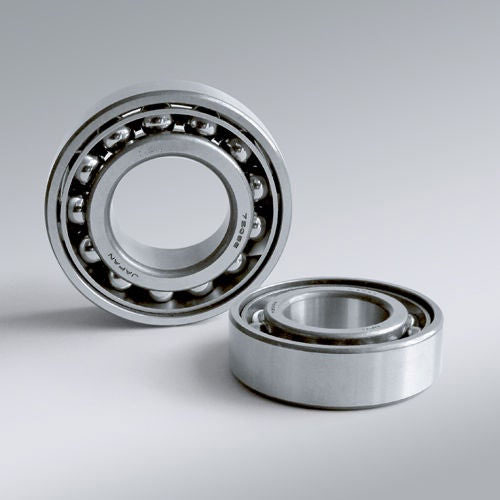
NMT's comprehensive range of angular contact ball bearings is designed to meet the ever-evolving requirements of equipment manufacturers.
Angular contact ball bearings feature a contact angle that sustains significant axial loads in one direction at the same time as radial loads.
Since an axial component is generated when radial load is applied, these bearings are typically used in pairs or multi-bearing sets.
Product List
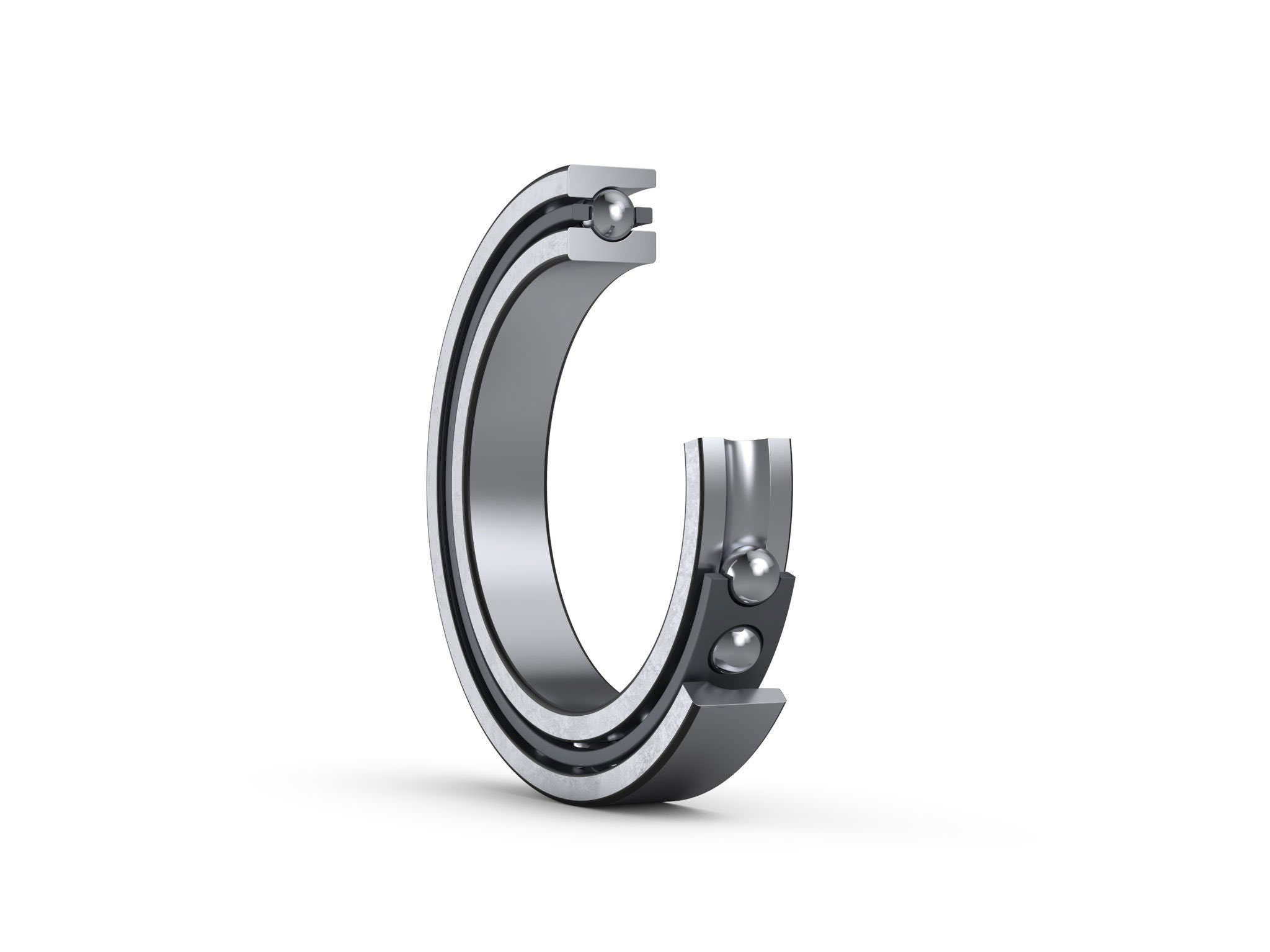
The structure of angular contact ball bearings produces an axial component when a radial or combined load is applied; therefore, two opposed bearings or a multi-bearing arrangement are used.
A preload is often used to increase the rigidity of single-row angular contact ball bearings, particularly in the main spindles of machine tools where high running accuracy is crucial.
Bearings with a contact angle of 30° (A) or 40° (B) typically use pressed steel, molded resin, or machined brass cages, though machined synthetic resin or specialized polyamide resin cages are used for certain applications.
Reference 1 Cages for Angular Contact Ball Bearings by Series
| Series | Pressed Steel Cages | Machined Brass Cages |
|---|---|---|
| 79A5,C | - | 7900-7940 |
| 70A | 7000-7018 | 7019-7040 |
| 70C | - | 7000-7022 |
| 72A,B | 7200-7222 | 7224-7240 |
| 72C | - | 7200-7240 |
| 73A,B | 7300-7320 | 7321-7340 |
Features
- Support both radial and axial loads
Single-row ACBBs can take radial loads and axial loads in one direction with typical contact angles of 30° or 40°. - A variety of contact angles
Larger contact angles offer greater capacity for axial loads, while smaller contact angles are better for high-speed rotation. - Two opposed bearings are used to adjust internal clearance. Pressed steel cages are common, though polyamide resin cages are typically used for high-precision bearings with contact angles under 30°.
Applications
- High rigidity
Ideal for applications requiring bearing rigidity. - Pumps, compressors, screw chillers, elevator hoists
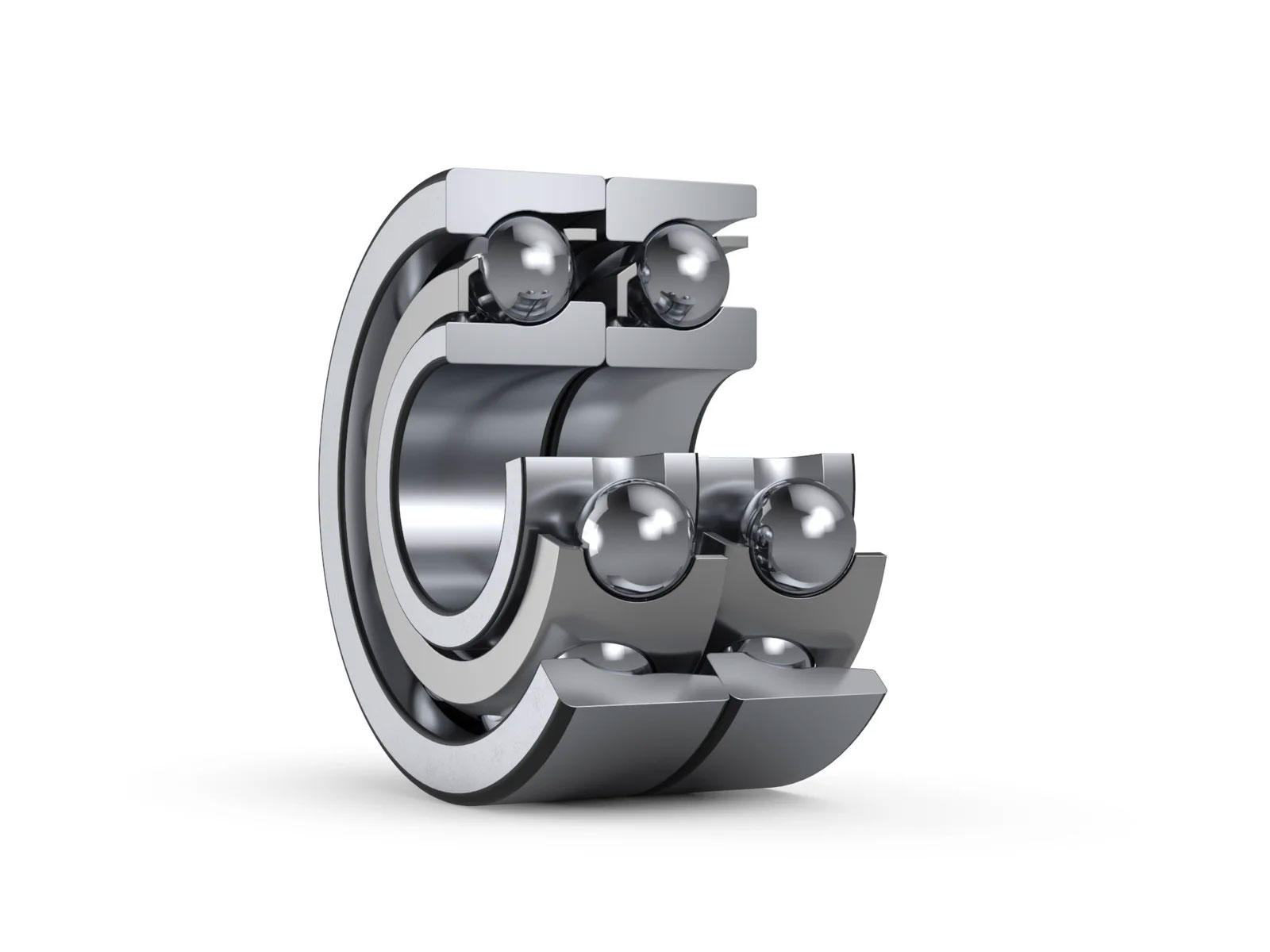
Matched angular contact ball bearings come in a variety of arrangement types to suit loads for a partciular application.
Types and Features of Matched Angular Ball Bearings
Features
- Flexible arrangements
Angular ball bearing sets are defined by how the bearings are oriented when combined. Bearings can be arranged with their outer ring front faces together (face-to-face/DF), with their back faces together (back-to-back/DB), or with faces aligned in the same direction (tandem/DT). - Support axial and radial loads
DF and DB arrangements can sustain radial loads and axial loads in both directions. DT arrangements are used for large axial loads in a single direction. - High precision
Precision class (P5 or above) arrangements are often used in the main spindles of machine tools. In these cases, a preload is applied based on operating conditions to adjust internal clearance. They also use a special fit.
Applications
- Pumps, compressors, screw chillers, elevator hoists
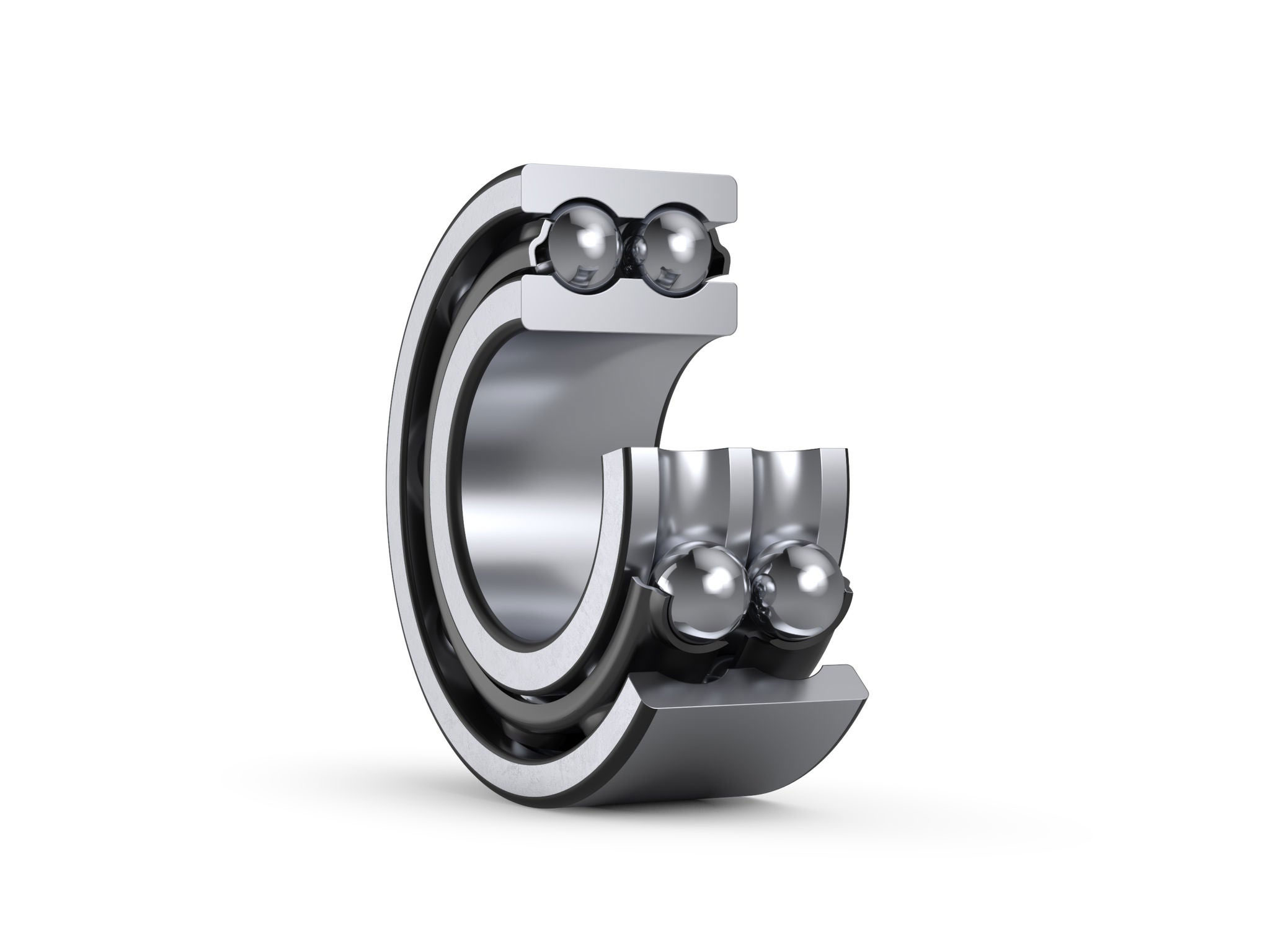
A back-to-back paired mounting of single-row angular contact ball bearings is turned into a bearing with a single inner ring and outer ring.
Double-row angular contact ball bearings are often used as fixed-end bearings as they can sustain axial loads in both directions and have the capacity to take moment loads.
These bearings feature pressed steel cages.
Features
- Compact design
An integrated back-to-back mounting of two single-row ACBBs in the form factor of a single inner ring and outer ring. - Support axial loads
Double-row ACBBs can take axial (thrust) loads in both directions.
Applications
- Compressors, press machines, automatic guided vehicles (AGVs), belt conveyors
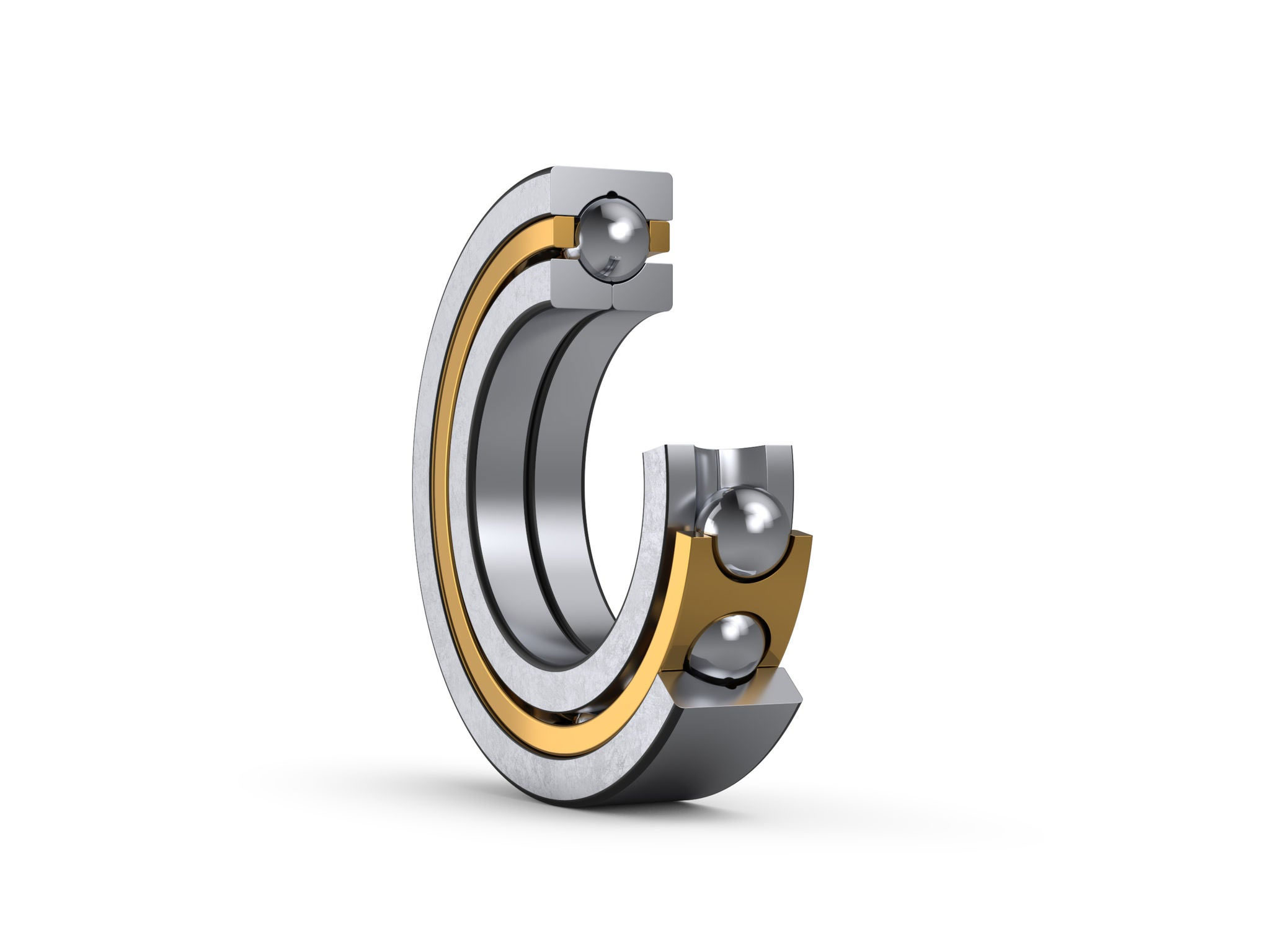
Four-point-contact ball bearings feature an inner ring split into two pieces. Just one of these bearings can sustain significant axial loads in both directions.
A contact angle of 35° allows for high axial load capacity. This type is suited for carrying pure axial loads or combined loads where the axial load is high.
These bearings feature machined brass cages.
Features
- Easy to handle
The outer ring of these specialized single-row angular contact ball bearings can be separated from the two halves of the inner ring split along a plane perpendicular to the shaft center. - High axial load capacity
With a contact angle of 35°, four-point-contact bearings are well-suited for pure or combined loads where axial load is high. - Compact
A single bearing can be used to replace a face-to-face or back-to-back arrangement of bearings.
Applications
- Tractor transmissions, robot gearboxes, servomotors
FAQs
 Loads are defined by their direction. Loads perpendicular to the shaft are called radial loads and loads parallel to the shaft are called axial (thrust) loads.
While DGBBs can handle axial loads in both directions, single-row angular contact ball bearings can only receive axial load in one direction.
Seals and shields offer additional protection for bearing components and help to improve and maintain lubrication. In terms of sealing performance, sealed bearings rank best, followed by shielded bearings, then finally open bearings. NMT uses supplementary designations D, DU, DW, and V (DD, DDU, DDW, VV) for sealed bearings and Z (ZZ) for shielded bearings. No supplementary designations are listed for open bearings.